News
Niger State Absorbs 396 UNICEF, GAVI-Supported Health Workers into Civil Service


By Daniel Ebi, Minna.
The Niger State Government has absorbed 396 health workers engaged under a UNICEF and GAVI-supported healthcare initiative into the state civil service as part of efforts to strengthen healthcare delivery and address manpower shortages across communities.
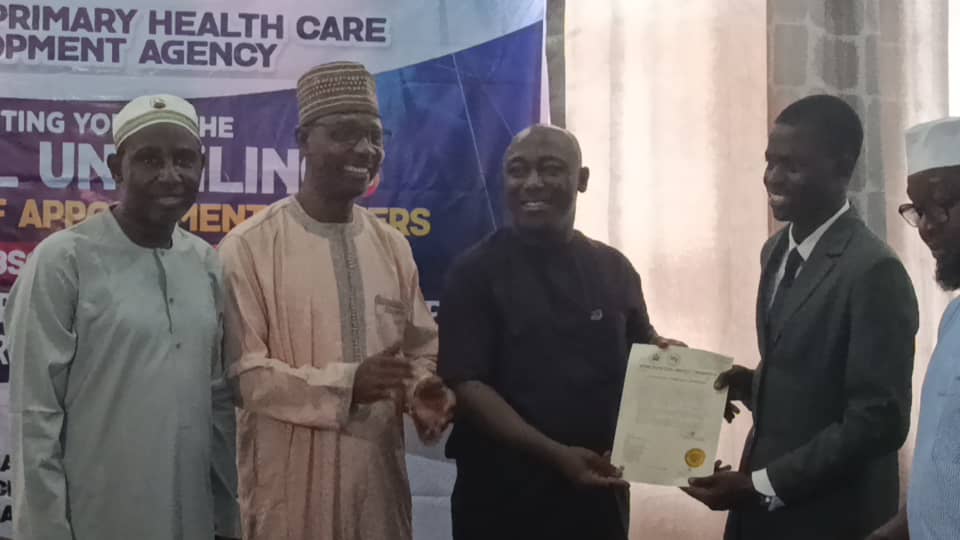
The official presentation of appointment letters to the affected personnel was held in Minna, where government officials reaffirmed the administration’s commitment to sustaining quality healthcare services at the grassroots.

Speaking at the ceremony, the Commissioner for Health, Murtala Mohammed Bagana, represented by the Permanent Secretary of the Ministry, Abdullahi Imam, said healthcare delivery largely takes place within communities and health facilities serving the people.
He explained that development partners, including UNICEF and GAVI, had earlier identified critical shortages of healthcare personnel across facilities in the state and initiated discussions with the government to address the challenge.
According to him, although the government may provide modern infrastructure and medical equipment, effective healthcare delivery cannot be achieved without adequate manpower.
He disclosed that the partners agreed to invest in young healthcare professionals with the understanding that the state government would eventually absorb them into permanent service because of the long-term nature of healthcare needs.
Imam noted that the previous administration of former Governor Abubakar Sani Bello signed a Memorandum of Understanding (MoU) to support the initiative, while Governor Muhammad Umar Bago sustained the commitment, leading to the eventual integration of the personnel into the state workforce.
The Commissioner further revealed that the newly absorbed workers comprise nurses, midwives and community health workers who had already spent between two and three years serving in various communities across the state.
He said the personnel would continue to serve in the same communities where they had built experience and established relationships with residents, adding that many of them could further their education and advance into higher professional cadres.
Bagana also commended Governor Bago for sustained investments in the health sector, disclosing that over 3,000 healthcare professionals, including doctors, pharmacists, nurses, laboratory scientists and community health workers, had been recruited within the last three years.
He added that about 116 Level Two healthcare facilities had been upgraded to improve access to maternal healthcare, immunisation, nutrition and laboratory services.
Earlier, the Executive Director of the State Primary Healthcare Development Agency, Inuwa Junaidu, described the absorption of the GAVI-supported staff as a demonstration of Governor Bago’s commitment to improving healthcare delivery in the state.
He stressed that human resources remain central to efficient healthcare service delivery.
Also speaking, the Programme Manager, Pharm. Daniel Jiya, described the event as the culmination of a three-year process driven by determination and collaboration among stakeholders.
He urged the newly absorbed staff to regard their appointments as a privilege and to strictly adhere to civil service regulations.